
The first quarter of 2026 has delivered a powerful shift in Ghana’s investment landscape. While treasury bill rates have dropped sharply into single digits, the Ghana Stock Exchange (GSE) has moved in the opposite direction—recording one of its strongest starts in recent history.
For individual investors, this contrast is not just interesting—it’s a signal. A signal that capital is rotating, opportunities are shifting, and strategy matters more than ever.
Let’s break down what’s happening.
1. Market Overview: Strong Index Performance
Across Q1 2026:
The GSE Composite Index (GSE-CI) recorded strong upward momentum.
The GSE Financial Stocks Index (GSE-FSI) outperformed significantly.
This reflects:
- Increased investor participation
- Strong demand for financial stocks
- Capital rotation from fixed income into equities
This shift is closely tied to falling treasury bill rates, which have reduced the attractiveness of low-risk instruments.
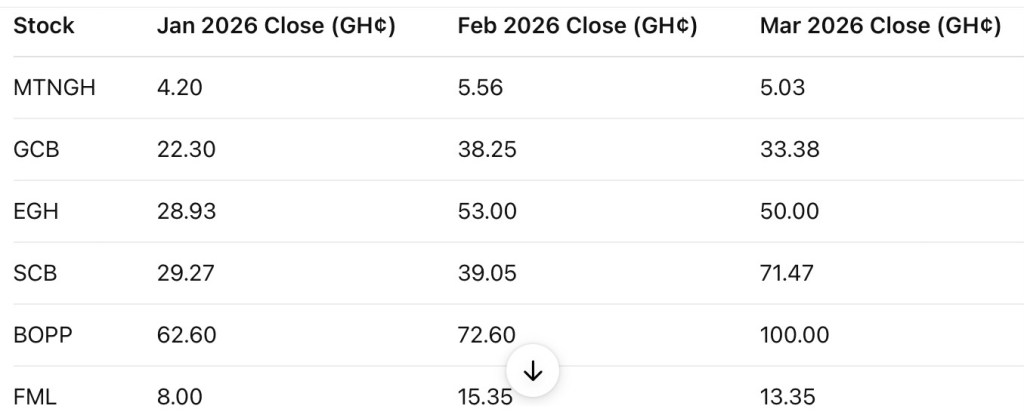
2. Stock Performance: January to March 2026
MTN Ghana (MTNGH)
MTN showed gradual upward movement across the quarter, with prices improving from January through March.
👉 Interpretation:
- Strong and consistent demand
- High liquidity supporting steady appreciation
- Investors positioning for dividends and long-term growth
GCB Bank (GCB)
GCB experienced a notable upward adjustment between January and February, followed by relative stabilization into March.
👉 Interpretation:
- Early-quarter revaluation driven by banking sector optimism
- Consolidation phase as investors hold positions
Ecobank Ghana (EGH)
EGH recorded strong gains early in the quarter, with prices increasing from January to February and holding firm into March.
👉 Interpretation:
- Strong institutional demand
- Investor confidence in earnings recovery
- Limited selling pressure
EGH stands out as a high-value, high-confidence stock.
Standard Chartered Bank Ghana (SCB)
SCB showed one of the most significant upward moves, particularly between January and February.
👉 Interpretation:
- Aggressive repricing by the market
- Strong demand from high-net-worth and institutional investors
By March, the stock entered a holding phase, indicating reduced short-term trading activity.
Benso Oil Palm Plantation (BOPP)
BOPP maintained a strong upward trajectory early in the quarter, followed by price stability.
👉 Interpretation:
- Strong fundamentals supporting valuation
- Limited float (few sellers)
- Long-term investor accumulation
BOPP continues to behave like a premium, long-term compounder.
Fan Milk Limited (FML)
Fan Milk remained relatively stable throughout the quarter, with minimal price movement.
👉 Interpretation:
- Defensive stock behavior
- Lower sensitivity to macro shifts
- Consistent but slower growth profile
This makes it attractive for income-focused and conservative investors.
3. Key Trend: Early Rally, Then Consolidation
One clear pattern emerges across most stocks:
👉 Significant price movement occurred between January and February
👉 Followed by stabilization in March
This tells us:
- The market has already reacted to falling interest rates
- Investors are now holding positions rather than chasing prices
We are in a consolidation phase, not a breakout phase
4. Why This Is Happening
a) Falling Treasury Bill Rates
With T-bill rates dropping to ~4–9%:
Fixed income returns are less attractive
Investors are reallocating into equities
Demand for stocks increases
b) Improved Economic Outlook
Lower inflation
Currency stability
Stronger corporate expectations
These factors support higher equity valuations.
c) Institutional Positioning
Large investors typically:
Enter early (January–February)
Accumulate positions
Hold through consolidation
That’s exactly what we’re seeing.
5. What This Means for You as an Investor
1. The Easy Gains May Already Be In
The sharpest price increases happened early in the quarter.
👉 Entering now requires more patience and strategy.
2. The Market Is Healthy, Not Overheated
Price stabilization in March is actually positive:
Reduces risk of a bubble
Signals strong hands holding stocks
Creates a base for future growth
3. Dividends Are Becoming More Attractive
With T-bills yielding less:
- Dividend-paying stocks become more competitive
- Income investors are shifting toward equities
6. Risks to Watch
Even in a strong market, stay alert:
Profit-taking: Investors may start locking in gains
Sector concentration: Banking stocks dominate performance
Policy shifts: Interest rate changes could reverse momentum
7. Smart Strategy Going Forward
1. Focus on Accumulation, Not Chasing
This is a positioning phase, not a hype phase.
2. Prioritize Quality Stocks
Strong picks include:
MTN (stability + dividends)
GCB / SCB (financial sector strength)
BOPP (long-term growth)
3. Maintain Balance
A smart portfolio should include:
T-bills (for safety)
Equities (for growth)
4. Watch for the Next Breakout
After consolidation, markets often move sharply.
👉 The next major opportunity may come when:
- Volume increases
- Earnings surprise positively
- Policy easing continues
Final Thoughts
This First quarter in 2026 (Q1) reveals a market that is not just rising—but evolving.
- Treasury bill rates are falling
- Stocks have repriced upward
- Investors are now consolidating positions
👉 The GSE will reward those who understood the shifts early—and act with discipline.
Compiled by Jill Boafo


Share your thoughts on this.
LikeLike