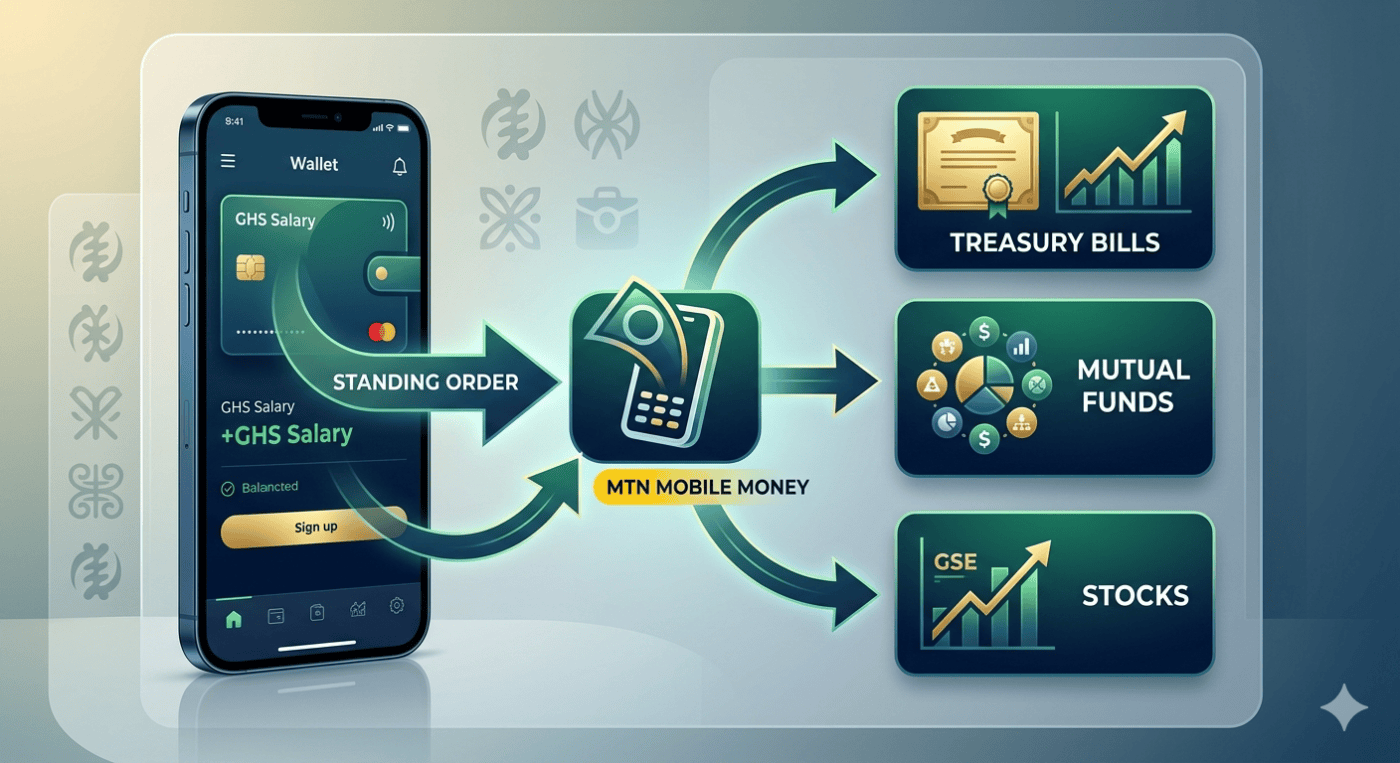
We have all been there. The salary hits your account at the end of the month, and for a brief moment, you feel financially secure. Then reality sets in: rent contributions, family obligations, utility bills, and the daily cost of living. You know you need to invest in Treasury bills, mutual funds, or equities on the Ghana Stock Exchange (GSE). Yet, by the time you sit down to calculate how much you can spare, the money has mysteriously dissolved into miscellaneous expenses.
Even if the funds are available, the mental effort required to log into an app, analyze market trends, and manually execute a transaction introduces decision fatigue. When investing requires active effort every single month, it becomes easy to skip “just this once.”
The secret to building long-term wealth in Ghana isn’t a massive windfall or timing the market perfectly. It is automation. By eliminating human emotion and manual effort from the equation, you can put your financial growth on autopilot.
Here is how to build a hands-off, highly efficient investment routine designed for the Ghanaian financial ecosystem.
The Power of the Financial “Set and Forget”
Most people follow a flawed financial formula:
The problem with this approach is that expenses naturally expand to fill your available income. To build wealth consistently, you must flip the equation:
Automation forces this habit. When your investments are deducted the moment your salary arrives, you learn to live on the remainder. You are no longer deciding whether to invest; the system is doing it for you.
1. Leveraging Local Banking and Mobile Money Automation
The Ghanaian fintech landscape has evolved significantly. You no longer need to walk into a bank branch or investment house to fill out paperwork every month. You can seamlessly connect your income source to your investment portfolios using two primary vehicles:
Standing Orders and Direct Debits
If you receive your salary through a traditional bank account (such as Ecobank, Stanbic, Absa, or GCB), a standing order is your most powerful tool. This is an instruction to your bank to automatically transfer a fixed amount of money to your investment firm on a specific date each month (preferably 24 to 48 hours after payday).
Most major asset management firms in Ghana offer collective investment schemes (Mutual Funds and Unit Trusts) that accept direct bank deposits. By setting up a recurring transfer to funds like the Databank Epack, Databank MFund, or First Star Mutual Fund, you build wealth quietly in the background.
Mobile Money (MoMo) Automation
For freelancers, contract workers, or those who prefer utilizing mobile wallets, Mobile Money automation has become highly sophisticated.
Platforms like MTN MoMo offer automated recurring payment features. Additionally, standard investment apps operating in Ghana (such as Achaba, Investcorp, or specialized micro-investment platforms) allow you to authorize automatic periodic debits directly from your MoMo wallet. If you know you receive payouts weekly or monthly, you can program your wallet to automatically sweep a portion into a high-yielding money market fund or treasury bill portfolio.
2. Dollar-Cost Averaging (DCA) on the Ghana Stock Exchange (GSE)
When people think of investing in individual stocks like MTN Ghana, GCB Bank, or TotalEnergies Marketing Ghana, they often worry about market volatility. Is the stock too expensive today? Will it drop tomorrow?
Trying to time the market is a losing game for busy professionals. Instead, an automated strategy relies on Dollar-Cost Averaging (DCA).
How DCA Works on the GSE
With DCA, you invest a fixed amount of money at regular intervals, regardless of whether the stock price is high or low.
- When prices are high: Your fixed amount buys fewer shares.
- When prices are low: Your fixed amount automatically buys more shares.
Over time, this strategy lowers your average cost per share and removes the anxiety of market fluctuations.
[Income] ──> [Automated Bank Transfer/MoMo Debit] ──> [Investment/Stock Portfolio]
To automate this on the GSE, you can work with licensed brokerage firms that offer automated retail platforms or periodic investment plans. By committing to buying, for example, GHS 500 worth of MTN Ghana shares on the 28th of every month, you accumulate significant assets over a 5-to-10-year horizon without ever looking at a daily stock chart.
3. Designing Your Hands-Off Investment Routine
To transition to a fully automated strategy without causing cash flow shocks, follow this three-step blueprint:
Step 1: Audit and Allocate
Look at your net monthly income and determine a realistic, sustainable percentage to automate. For young graduates, this might be 10% to 15%; for established working professionals, aiming for 20% to 30% is ideal. Divide this allocation across your financial goals:
- Short-term/Emergency (High liquidity): Automated Tier-2 or Tier-3 pension contributions, or a Money Market Mutual Fund.
- Medium-term (Growth & Stability): Government Treasury Bills or balanced mutual funds.
- Long-term (Aggressive growth): GSE Equities (Stocks).
Step 2: Establish the Infrastructure
Set up the digital links. If you are investing in T-Bills, use your bank’s treasury portal or mobile shortcodes (like 713# or bank-specific USSD codes) to set up rolling reinstatements where both principal and interest automatically reinvest (roll over*) upon maturity. For mutual funds and stocks, submit your direct debit mandates to your bank or authorize the recurring token on your investment app.
Step 3: Align with Your Pay Cycle
Timing is everything. If your salary typically arrives on the 25th, schedule all automated debits for the 26th or 27th. This ensures the money is swept away before you have the opportunity to spend it impulsively.
Overcoming the “Out of Sight, Out of Mind” Fear
A common psychological barrier to automation is the fear of losing control. It can feel uncomfortable to watch money leave your account automatically.
To counter this, schedule a Quarterly Financial Review.
Spend just 30 minutes every three months logging into your various investment portals to review your statements, track your portfolio growth, and ensure all automated triggers executed correctly. This keeps you informed and motivated without requiring daily or weekly intervention.
Conclusion
The difference between financial security and constant financial stress isn’t how much you earn—it is how you manage what you earn. Relying on willpower to save and invest every month is a strategy bound to fail in the face of modern temptations and economic pressures.
By harnessing standing orders, mobile money automations, and the principle of Dollar-Cost Averaging, you transform investing from a stressful monthly chore into a quiet, background utility.
Set up your automation architecture this week, step back, and watch your wealth grow on autopilot.
Like 👍, Comment💌 and Share to someone who could benefit from this too.
By Jill Boafo


Very deep🫡 financial security
LikeLiked by 1 person