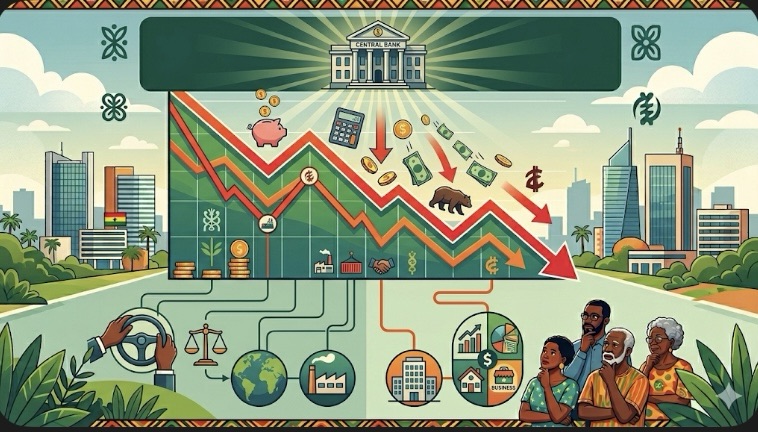
If you’ve been tracking treasury bill (T-bill) rates in Ghana recently, one thing is clear—they’ve dropped significantly.
The latest data from the Bank of Ghana shows that as of mid-March 2026, rates are hovering around:
- 91-day bill: ~4.7%
- 182-day bill: ~6.3%
- 364-day bill: ~9.4%
Compare this to just a year or two ago when short-term yields were well above 20%, and you begin to appreciate how dramatic this shift has been.
So what’s driving this decline—and more importantly, what should you do about it as an investor?
1. Why Treasury Bill Rates Are Falling
To understand the drop in T-bill rates, you need to look at the broader economic picture.
a) Falling Inflation
Ghana has experienced a sharp decline in inflation over the past year. Inflation dropped from crisis levels above 50% in 2023 to single digits by late 2025.
Lower inflation reduces the need for high interest rates. When prices are stabilizing, investors don’t demand extremely high returns to preserve purchasing power.
b) Monetary Policy Easing
The Bank of Ghana has been actively cutting its policy rate to support economic recovery. In early 2026, the policy rate was reduced to around 15.5%, following multiple cuts in 2025.
Since T-bill rates are closely tied to the policy rate, they naturally trend downward when monetary policy becomes more accommodative.
c) Improved Economic Stability
Ghana’s macroeconomic outlook has improved significantly—currency stability, declining inflation, and stronger growth projections have all contributed to lower risk levels.
When government risk is perceived to be lower, it doesn’t need to offer high yields to attract investors.
2. What Low T-Bill Rates Mean
For Individual Investors
The most obvious impact: lower returns on safe investments.
If you’re used to earning 15–25% on T-bills, seeing single-digit yields can feel disappointing. In real terms (after inflation), returns may still be positive—but much smaller.
For the Government
Lower T-bill rates are actually good news for the government. It means:
Cheaper borrowing costs Reduced debt servicing pressure More fiscal space for development spending
This is especially important given Ghana’s recent debt restructuring efforts.
For the Economy
Lower interest rates generally encourage:
Borrowing by businesses Investment and expansion Economic growth
So while investors may earn less, the broader economy tends to benefit.
3. What Investors Typically Do When Rates Are Low
When T-bill rates drop, investor behavior shifts in predictable ways:
a) Move to Longer-Term Instruments
Instead of 91-day bills, investors may prefer:
182-day bills 364-day bills Government bonds
This helps lock in relatively higher rates before they fall further.
b) Shift to Risk Assets
Some investors start moving into:
Stocks (especially on the Ghana Stock Exchange) Real estate Business investments
This is because the opportunity cost of leaving money in T-bills becomes higher.
c) Increase Reinvestment Frequency
Short-term investors may keep rolling over funds, hoping rates will rise again.
4. The Hidden Opportunity in Low Rates
Low T-bill rates aren’t just bad news—they signal something important:
👉 The economy is stabilizing.
👉 Inflation is under control.
👉 Risk premiums are falling.
These are exactly the conditions where wealth is built through smart asset allocation, not just parking money in fixed income.
5. What You Should Do as an Investor Right Now
Here’s a practical approach if you’re trying to make money in this environment:
1. Don’t Abandon T-Bills Completely
T-bills still serve a purpose:
Capital preservation Emergency funds Short-term liquidity
Think of them as your financial foundation, not your growth engine.
2. Lock in Longer Tenors (Smartly)
If you believe rates may fall further, consider:
Allocating more to 364-day bills (~9% range) Gradually building positions over time
This protects you from reinvestment risk.
3. Start Exploring Equities (Carefully)
With T-bill returns dropping, stocks become more attractive.
Focus on:
Dividend-paying companies Strong fundamentals Undervalued opportunities
This is where your long-term wealth can grow faster than inflation.
4. Think in Portfolios, Not Single Investments
A smart mix could look like:
30–50% T-bills (stability) 20–40% stocks (growth) 10–20% cash or business opportunities
The goal is balance—not chasing returns blindly.
5. Pay Attention to Trends, Not Just Current Rates
Rates won’t stay low forever.
Watch:
Inflation trends Monetary policy decisions Government borrowing patterns
These will tell you where yields are heading next.
Final Thoughts
The current drop in treasury bill rates in Ghana is not a crisis—it’s a transition.
A transition from:
High inflation → price stability Crisis → recovery Easy fixed-income gains → more strategic investing
For years, T-bills were the “easy money” play. Now, the game is changing.
And for investors, this is where things actually get interesting.
If you position yourself well—balancing safety with growth—you won’t just survive this low-rate environment.
You’ll build more sustainable wealth from it.
Thanks for passing by:
Compiled by Jill Boafo


Share your thoughts on this. What trends are we expecting the rest of this year 2026
LikeLike